In chapter 16, the Joads and the Wilsons travel together as one family. When the Wilson's car breaks down, Tom and Casy volunteer to stay behind to fix it while the others move on. This angers Ma Joad. She wants the family to stay together, no matter what. She says that is all they have left - family. The family splits up anways and when the car is fixed, the family is reunited at a crowded camp. At the camp, a man tells Pa Joad that there is no work in California and that the employers in California are all liars.
In chapter 17, a macrocosm point of view is taken on instead of the microcosm view taken on in chapter 16. It talks about how the migrant farmers all lived together in camps as if they were family. And they were like one whole family with rules governing how one should behave and punishments for the misconducts.
The first chapter, 16, gives a personal sense of exactly what traveling on the road and living with others was like. Chapter 17 is just a generalized version of what most migrants went through. The personal account in 16 gives more detail is is a lot more vivid. Additionally, the Joad family encounters a person who tells them exactly what life is like in California. Most migrants would not have known and would have kept traveling towards their unattainable goal of making a living in the state.
Chapter 16 shows exactly what the Joads are facing. They faced the man who gave them the cold hard truth about California. They faced breaking up the family when the car broke down. There were intense moment, especially the moment in which Ma Joad opposed breaking up the family. There were actual feelings that had shown through the detailed events of each character.
These two types of chapters help bring the whole novel together. Not only do readers get "the big picture" from the macrocosm point of view, but also the thorough and comprehensive view of one family's journey into the unknown from the microcosm.
Sunday, March 23, 2014

Tuesday, March 18, 2014
C. Poem (Chapter 16-19) *
This poem is from the point of view of a farmer. The theme is hunger and this poem explores how self-reliance is not important at this time.
Hunger
I'm starving
He's starving
Everybody's starving
Got some food?
Share it please
Feed the hungry
And insure yourself
How wonderful it would be
To be fed when you need it
Everybody shares
And we all won't starve
Hiding your food?
Don't want to share?
We all see you there
We'll shun you and
Make you an ostrich
For your money is spent badly
For your selfishness
Hunger
I'm starving
He's starving
Everybody's starving
Got some food?
Share it please
Feed the hungry
And insure yourself
How wonderful it would be
To be fed when you need it
Everybody shares
And we all won't starve
Hiding your food?
Don't want to share?
We all see you there
We'll shun you and
Make you an ostrich
For your money is spent badly
For your selfishness
Monday, March 17, 2014
D. Impacting Quote (Chapter 11-15) *
"She looked at him and smiled secretly. She was all secrets now she was pregnant, secrets and little silences that seemed to have meetings. She was pleased with herself, and she complained about things that didn't really matter. And she demanded services of Connie that were silly, and both of them knew they were silly. Connie was pleased with her too, and filled with wonder that she was pregnant. He liked to think he was in on the secrets she had. When she smiled slyly, he smiled slyly too, and they exchanged confidences in whispers. The world had drawn close around them, and that they were in the center of it, or rather Rose of Sharon was in the center of it with Connie making a small orbit about her. Everything they said was kind of a secret." (129)It's quite amazing how Rose of Sharon and Connie can find happiness within each other, even in the direst of situations, such as the one they are in now. Through losing their home and all their material belongings, they have become even closer. They only need each other. Humans are weird that way. We can be barely surviving, but if we are surrounded by people we love, we'll think we're on top of the world and we don't need anything more.
When I read this quote, I remembered back to a class activity in which I was told to put a price on one of my most sentimental thing, a journal, to sell it. The journal has pictures and random stuff that has meaning to me. It's everything. Obviously, I priced it at $50,000. But to think of how Rose of Sharon and Connie had to leave everything behind, now that's crazy. I can't imagine that happening to me. But, at least, they have each other. If I were to leave every thing I owned behind but still keep my close friends and family with me, I'd think I'd be okay. I could create new memories. And maybe life would be better without all those material things anyways. The intangible parts of the life are the best parts of life.
Additionally, they're the perfect couple. They share secrets and are the centers of each others worlds. I was reading an article on Psychology Today titled Why We All Need to Belong to Someone and it reminded me of this quote. It's cute how Connie tries to belong to Rose of Sharon by thinking he is in on the secrets she has. And its cute how Rose of Sharon demands silly things of Connie. It shows how close they are and how well they belong together.
Wednesday, March 12, 2014
B. Highway 66 (Chapter 11-15)
The Joads' journey to California begins in Sallisaw, Oklahoma and leads them to Route 66.
On the way there, the Joads have to stop at a service station for water and gasoline. There, the Joads' poor dog dies. This is significant because the dog was part of the Joads' old life - the one they had to leave behind to start new lives in California. They most likely had the dog to help herd farm animals that of which they do not have anymore. Or they could have had the dog as a companion. But they are leaving everything behind, so the dog has to go too.
 On the end of the first day of their trip, the Joads decide to stop to rest with another family, the Wilsons. Poor Granpa suffers a stroke and passes away. Granpa did not want to leave his old farm life. He didn't want to let go - he wanted to stay. Therefore, he had to pass away. To go to California meant to leave everything behind and to start new lives.
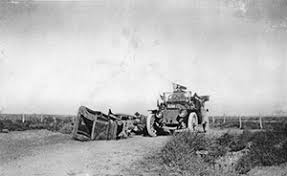 On this road, the Joads and other migrants have their perseverance tested. How far can they go without wanting to turn back to their old lives? Can they accept the losses they will go through?
On the way there, the Joads have to stop at a service station for water and gasoline. There, the Joads' poor dog dies. This is significant because the dog was part of the Joads' old life - the one they had to leave behind to start new lives in California. They most likely had the dog to help herd farm animals that of which they do not have anymore. Or they could have had the dog as a companion. But they are leaving everything behind, so the dog has to go too.
Friday, March 7, 2014
H. Repetition (Chapter 1-10)
"In the town, on the edges of the towns, in fields, in vacant lots, the used- car yards, the wreckers' yards, the garages with blazoned signs—Used Cars, Good Used Cars. Cheap transportation, three trailers. '27 Ford, clean. Checked cars,guaranteed cars. Free radio. Car with 100 gallons of gas free. Come in and look. Used cars." (61)Steinbeck's repeated use of the word "car" almost makes it seem like there is no meaning to it - like the cars are not really cars anymore. It's called Semantic satiation. It happens when you say a word over and over again until it has no meaning to you. It just becomes meaningless sound.
And they aren't really cars. They're broken, filled with sawdust and have no working batteries. They're a pile of rusted metal, that's what they are. And they're sold for prices way above what they're really worth.
All these adjectives, "good", "cheap", "clean", used to falsely describe an object. Steinbeck uses these words sarcastically to describe the lengths of which the car dealers tried to reach to sell these incredibly worthless junk cars.
Thursday, March 6, 2014
G. Man Vs. Society (Chapter 1-10)
On page 37, a banker tries to take land from a farmer who was not producing goods and was not paying bills.
On page 37, a farmer takes a tractor driving job that makes everyone in his farming community lose their jobs.
"It's our land. We measured it and broke it up. We were born on it, and we got killed on it, died on it. Even if it's no good, it's still ours. That's what makes it ours - being born on it, working it, dying on it." (33)The bank is the society because it is taking basically everything from the a person. This is crucial to the plot because it causes the huge farmer migration westward and additionally shows the harshness of big businesses, corporations and the government back then. Each person had to fight for themselves.
On page 37, a farmer takes a tractor driving job that makes everyone in his farming community lose their jobs.
"'Three dollars a day. I got damn sick of creeping for my dinner--and not getting it. I got a wife and kids. We got to eat. Three dollars a day and it comes every day.'
'But for your three dollars a day fifteen or twenty families can't eat at all. Nearly a hundred people have to go and wander on the roads for your three dollars a day. Is that right?'" (37)
The society is the farmer's neighbors. He has to take this job in order for him to survive. It develops the idea in the story that if you don't look out for yourself, no one will. For example, the banker from the first quote - he does not want to take the land from the farmer, but he has to because he is paid to do it and has to support his own family with the money he earns.
Wednesday, March 5, 2014
D. Vehicle Industry of the 1930s (Chapter 1-10)
In the year of 1930, car production had dropped from a whopping 5.3 million cars to just 2.4 million. The economy is extremely dependent on the auto industry, so this drop had a great affect on the well being of America's financial sector at the time. People realized the importance of this industry after the stock market crash of 1929.
Small car companies in the 1929, such as Pierce-Arrow, Peerless, or Stutz, could not survive through the depression. Most of these companies made expensive, special-made cars and most people at the time could barely afford the cheaper, run-off-the-mill cars. These companies were put out of business.
Some bigger car companies managed to survive, however. The "Big Three", General Motors, Ford, and Chrysler, sold more affordable cars because they had mechanized most of the car production process. Because they were more efficient, they could sell their cars to the public at lower prices.
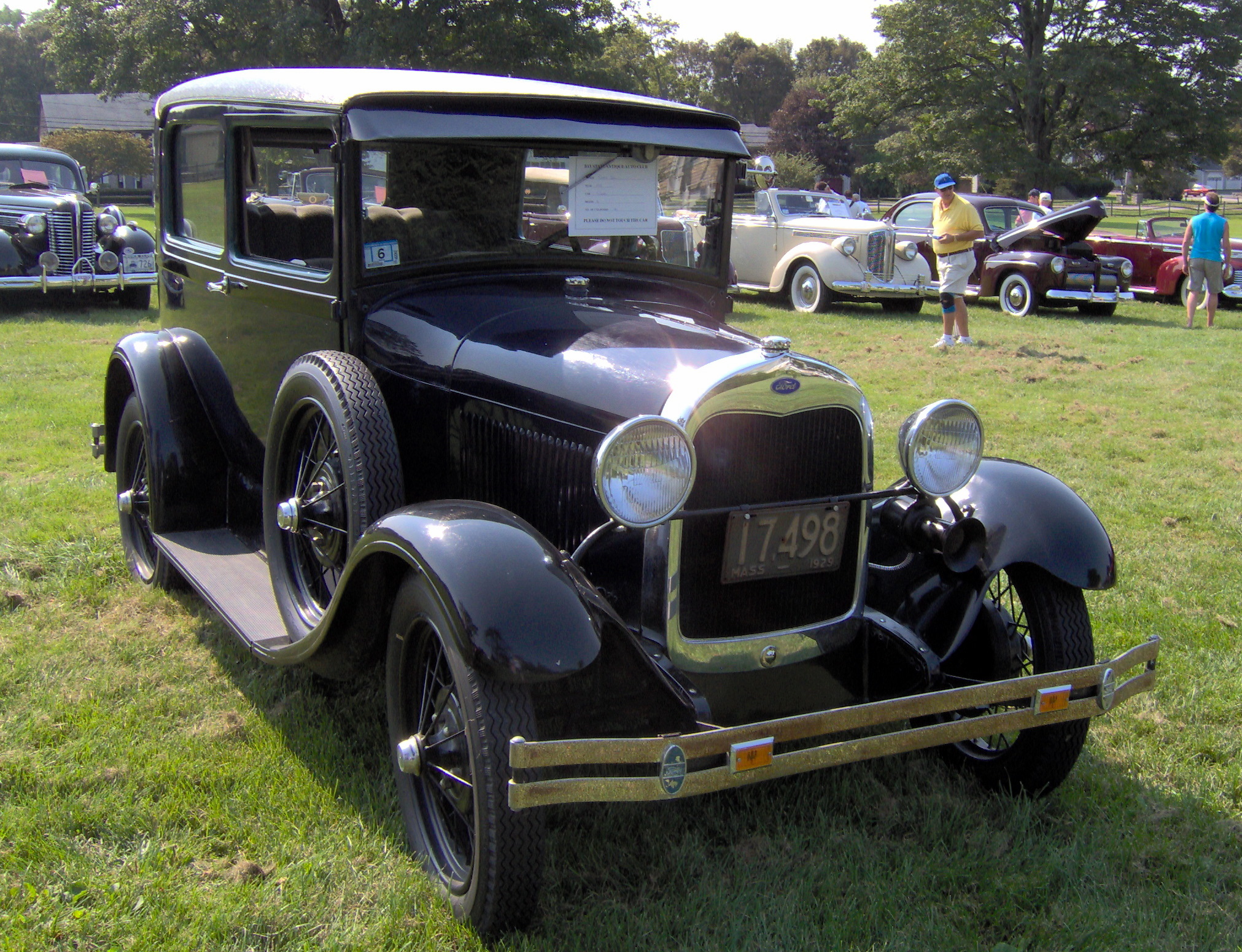
The most popular car at the time was the Model A by Ford Motor Company.
Small car companies in the 1929, such as Pierce-Arrow, Peerless, or Stutz, could not survive through the depression. Most of these companies made expensive, special-made cars and most people at the time could barely afford the cheaper, run-off-the-mill cars. These companies were put out of business.
Some bigger car companies managed to survive, however. The "Big Three", General Motors, Ford, and Chrysler, sold more affordable cars because they had mechanized most of the car production process. Because they were more efficient, they could sell their cars to the public at lower prices.
The most popular car at the time was the Model A by Ford Motor Company.

It costs $500 at the time, which translate to approximately $5000 today. Three million were sold by 1930. Even though this was a big sum for most families, most families in the Mid West coughed up this amount to escape the Dust Bowl and move West.
Monday, March 3, 2014
C. Love Letter (Chapter 1-10)
Dear land,
Please take me back. Oh how I'll love you so. I'll take care of you, I promise. "If [your] dust only wouldn't fly. If [your] top will stay on the soil."(32) I will rotate crops and keep you healthy. I didn't know cotton would "suck all the blood out of [you]."(32)
Please let me produce crops. I need them to survive and provide for my family. "We're half starved now. The kids are hungry all the time. We got no clothes, torn an' ragged."(33)
I've been here forever and I'll be here always. I "had to kill the Indians and drive them away" to stay with you. (33) My son was "born here and he killed weeds and snakes" on this land. (33) See all the good memories we've had together? I was "born on [you]" and I will "[die]" on you. (33)
If you do not produce, my family will have to leave you. I don't want to let you go, but you've been unproductive and the "monster" will come to push me off of you.(34) I'm sorry it has to come to this. Don't worry, I'll "fight to keep" you. (34)
Love,
Grampa
Please take me back. Oh how I'll love you so. I'll take care of you, I promise. "If [your] dust only wouldn't fly. If [your] top will stay on the soil."(32) I will rotate crops and keep you healthy. I didn't know cotton would "suck all the blood out of [you]."(32)
Please let me produce crops. I need them to survive and provide for my family. "We're half starved now. The kids are hungry all the time. We got no clothes, torn an' ragged."(33)
I've been here forever and I'll be here always. I "had to kill the Indians and drive them away" to stay with you. (33) My son was "born here and he killed weeds and snakes" on this land. (33) See all the good memories we've had together? I was "born on [you]" and I will "[die]" on you. (33)
If you do not produce, my family will have to leave you. I don't want to let you go, but you've been unproductive and the "monster" will come to push me off of you.(34) I'm sorry it has to come to this. Don't worry, I'll "fight to keep" you. (34)
Love,
Grampa
Subscribe to:
Comments (Atom)